
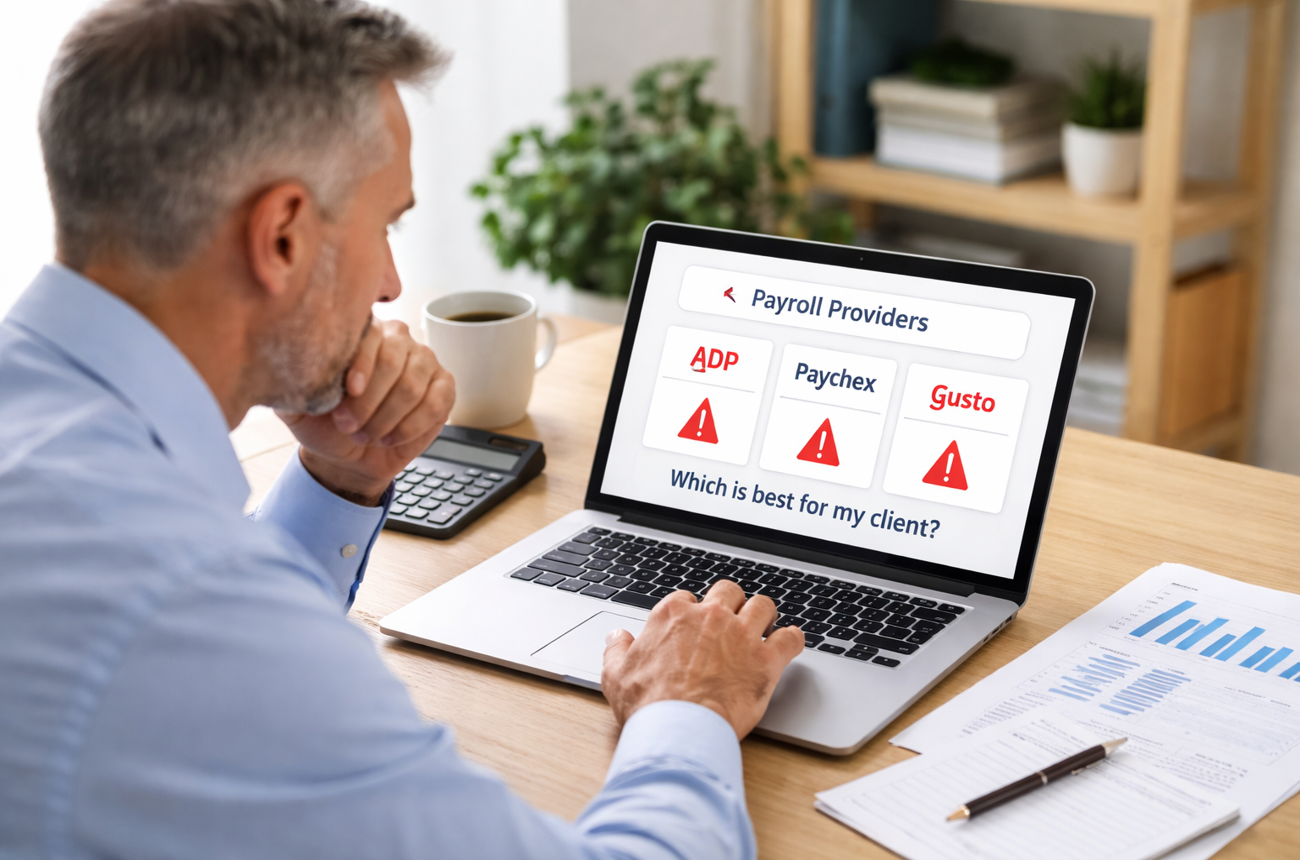
When payroll issues come up during client meetings, CPAs are often put in an uncomfortable position.
A business owner asks:
“Who should we use for payroll?”
And suddenly, the CPA is expected to give a recommendation — even though payroll software, compliance rules, and provider capabilities change constantly.
Many CPAs already know this instinctively:
recommending a payroll provider can be risky, especially when the recommendation comes from someone who is financially tied to a single platform.
Yet, business owners still want guidance. And ignoring the question isn’t an option.
So what’s the right approach?
Most payroll recommendations don’t come from a place of objectivity. They come from:
That doesn’t make the recommendation malicious — but it does make it incomplete.
Payroll providers are built for different types of businesses:
When a provider is recommended without evaluating the client’s current reality, the CPA often ends up dealing with the fallout.
Most payroll issues don’t start as “big problems.” They start quietly:
Eventually, those issues surface during tax prep or year-end review — and clients look to their CPA to help untangle them.
At that point, the question isn’t:
“Which payroll provider is best?”
It’s:
“Is this a setup issue, a system limitation, or the wrong platform entirely?”
In our experience, most payroll problems aren’t caused by bad software.
They’re caused by:
This is where CPAs benefit from having an objective payroll resource.
Someone who can quickly determine:
That distinction saves CPAs time — and protects the CPA-client relationship.
When a payroll advisor is tied to one provider, the solution often looks the same regardless of the problem.
Vendor neutrality changes that.
A neutral payroll partner evaluates:
Only then does a recommendation make sense.
This approach removes pressure from the CPA to “pick a system” and instead positions them as the advisor who brought in the right specialist at the right time.
Rather than recommending a specific payroll provider, many CPAs now take a different approach:
“Let’s have someone review your payroll setup and make sure it actually fits your business today.”
This accomplishes three things:
Most importantly, it keeps payroll from becoming a distraction during tax season.
At Segura Gallo HR & Consulting, we work alongside CPAs as a vendor-neutral payroll partner.
We evaluate all major payroll platforms — including ADP, Paychex, Paylocity, Gusto, QBO, and PEO options — and determine whether a client’s issue is:
CPAs stay informed, clients get clarity, and no one is pushed into a one-size-fits-all solution.
